Intelligent patch achieves medical approval in record time
A DTU start-up has developed a new sensor for monitoring patients in an easier, smarter, and better way. The next step is commercialization and expansion outside Denmark.
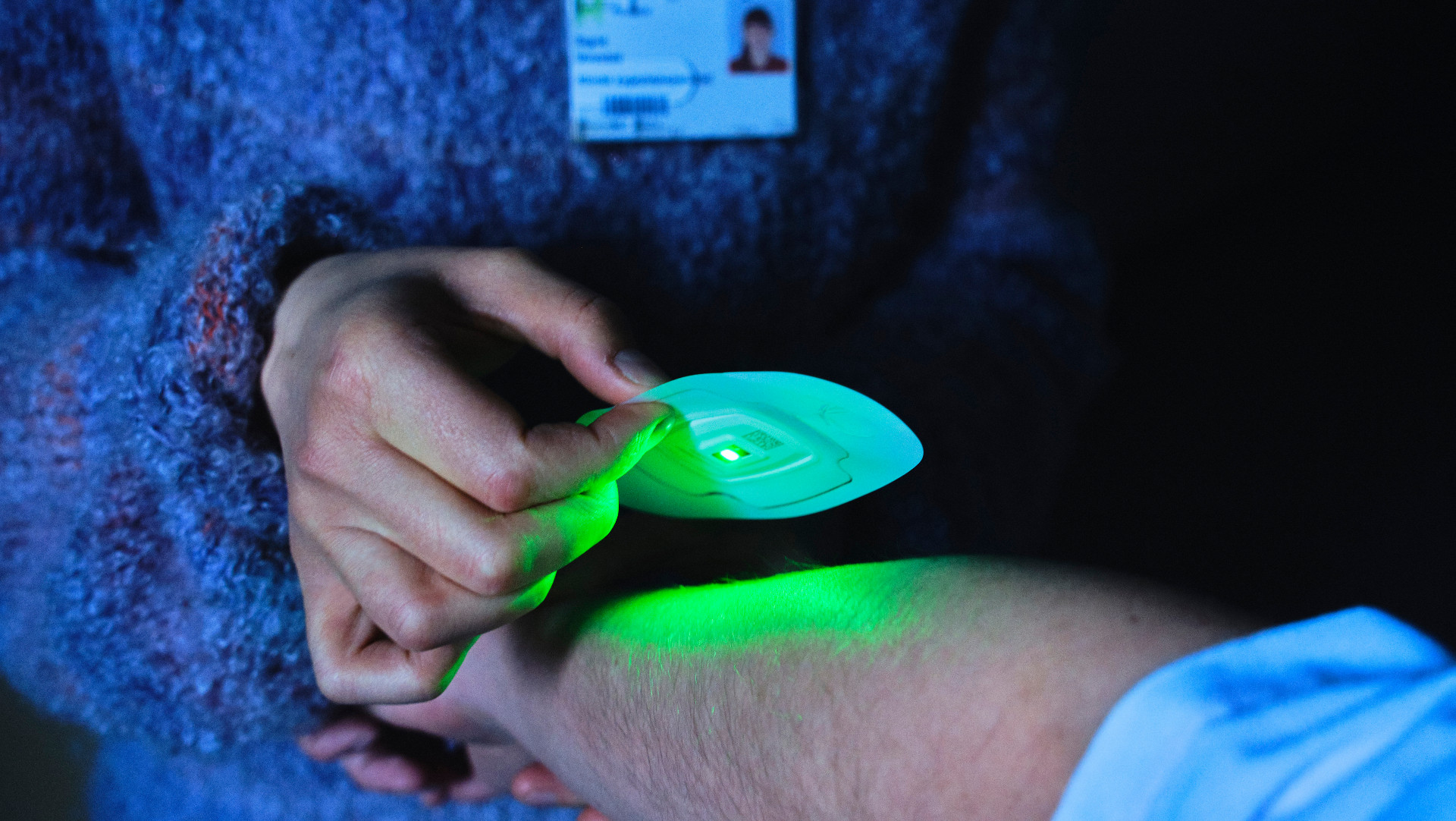
Entrepreneurs develop the software for intelligent patches themselves. Photo: Magnus Møller
Tuesday 05 May 2026
Christina Tækker
Six years ago, three former DTU students came up with the idea of an intelligent patch with a wireless sensor that quickly provides a picture of the patient’s condition and boosts patient safety. Today, the medtech company IMP Scandinavia has obtained medical approval for the intelligent patch in just ten months—a major commercial milestone opening the door to the European market.
This is a so-called MDR class IIb approval, which means that the product is thoroughly tested and assessed and officially approved for use on patients in the EU under some of the strictest medical requirements.
The intelligent patch has been developed in a Danish healthcare system under pressure from more and older patients, a lack of healthcare professionals, and large-scale hospitals with single rooms. It is based on a wireless medical sensor that continuously measures heart rate, oxygen saturation, blood pressure, respiration, and movement, and can strengthen patient safety, free up staff time, and support both hospital and home monitoring.
“We’re looking at a future where many patient groups will be sent home for hospital-at-home care. So instead of having the doctor measure their blood pressure, many patients will be doing it themselves and then sending the results to the doctor or hospital. Here, the patient’s condition will be monitored, and it will be assessed whether further treatment is needed. In this way, diseases can be detected early and hospitalization avoided. This can lead to major socio-economic gains,” says Brian Christensen, co-founder of the company.
Met at Ballerup Campus
Brian Christensen met the other two co-founders, Jeppe Damgaard Leth and Oliver Kjæp Karlsson, on a business innovation course at DTU Ballerup Campus, where students learn to develop technologies to solve some of society’s challenges.
Since its establishment in 2020, IMP Scandinavia has received a double-digit million amount (in DKK) in grants from private investors, Innovation Fund Denmark, and Otto Bruun’s Fund, among others. The entrepreneurs have participated in several accelerator programmes such as the Danish Tech Challenge, which is a competition for high-tech start-ups focusing on IT hardware. They have also been part of the Copenhagen Health Innovation partnership, which aims to create a better healthcare system for the benefit of patients, and conducted research projects carried out in the everyday lives of citizens and patients.
Large market for monitoring
The entrepreneurs themselves develop the software for the patch. The readings are transmitted via wireless beacons, which are little radio transmitters, to a laptop or tablet. From here you can follow the development over time. The sensor holds enough power for approx. 24 hours, is sustainable, and can be removed from the patch and recycled.
“We’re seeing a large market for monitoring, and right now we don’t experience any direct competition. There are companies that work with the same needs as us, but no one is developing the same solution. Plus, we’re making it smarter and easier. Instead of developing a technology that uses Wi-Fi or Bluetooth, which requires a password and internet connection, we have developed a solution that only requires two sockets—one for the charger and one for beacons. This means that anyone can use our product,” says Brian Christensen.