Water technology

Can wastewater be reused in pharmaceutical production?

DTU is analyzing and risk-assessing treated wastewater from production at Novo Nordisk. If the water is clean enough, the company can reuse it in production and potentially halve its water consumption.

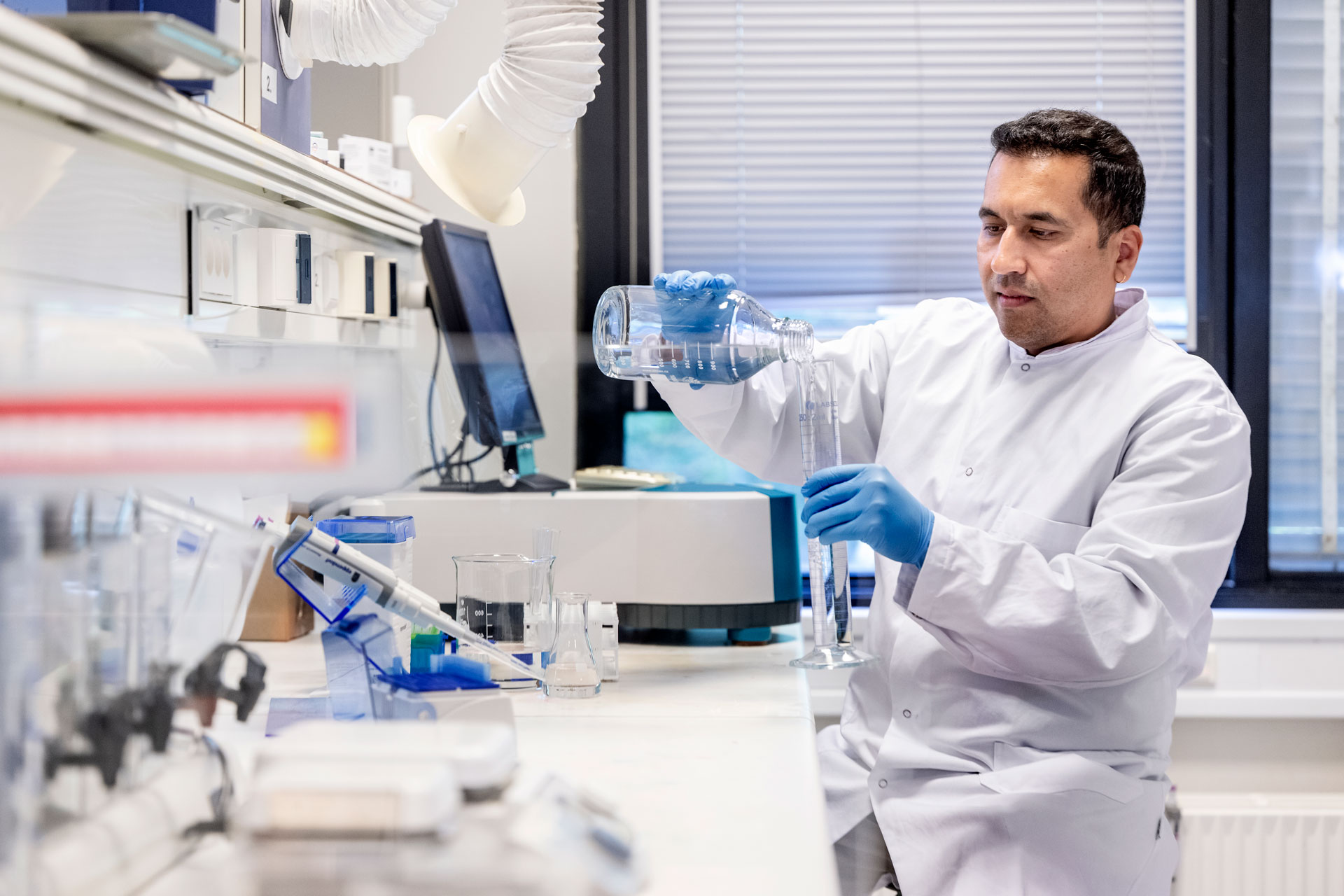
Senior Researcher Ravi Kumar Chhetri from DTU Sustain is working with several companies to help them reduce their water consumption. Photo: Bax Lindhardt
”If we can recycle the wastewater streams that come from the processes in the pharmaceutical production itself, we estimate that we can reduce our water consumption by 50 per cent.”
Andreas Herfelt Novo Nordisk

Recycling has great potential

DTU's experts in water treatment and purification can help answer that question. One of them is senior researcher Ravi Kumar Chhetri from DTU Sustain. He is collaborating with several Danish companies to reduce their water consumption, where water recycling is of increasing interest, he says:

"Recycling water in a production company has great potential for water savings compared to other water-saving measures such as optimizing processes with high water consumption."

Together with Novo Nordisk in Hillerød, Ravi Kumar Chhetri is investigating whether treating the company's process water can lead to water that is so pure that it can be reused in production. The authorities have very strict requirements for the quality of the water used in pharmaceutical production, says Andreas Herfelt:

"This is because the water used in the production of pharmaceuticals - and especially those that are to be injected - is subject to the strictest quality requirements. This is to prevent unwanted substances from ending up in the patients who need the medicine."

DTU provides documentation

In December 2025, Ravi Kumar Chhetri installed water-purifying membrane technology at Novo Nordisk in Hillerød. The membrane technology is based on reverse osmosis (see fact box). From here, water samples are taken for ongoing analysis at DTU to obtain data on how clean the water is on the other side of the membrane.

The data forms the basis for the risk analyses that Ravi Kumar Chhetri also prepares in collaboration with his colleague Professor Anders Baun.

“In the risk analyses, we assess whether there are substances remaining in the purified water and whether they pose a high or low risk. If the risk is at the high end, we look at how to address it,” says Ravi Kumar Chhetri.

The analyses are intended to help Novo Nordisk document that the water can be made clean enough that it can be reused.

“It is with DTU’s help that we can obtain the necessary data for the Danish Medicines Agency as documentation that recycling the water will not pose any risk to either the quality of our products or patient safety,” says Andreas Herfelt.
Facts

  • Reverse osmosis is a well-known filtration technique for, among other things, water purification.
  • A membrane allows water to pass through, while unwanted substances are retained.
  • At Novo Nordisk in Hillerød, a solution is being tested where the wastewater passes through a membrane that retains ions such as boron, sodium and silicate.

Significant reduction in water consumption possible

In a pharmaceutical company, there are many different wastewater streams, and they vary in purity. For example, there is a wastewater stream after rinsing equipment, tanks and systems. The more rinses, the cleaner the wastewater in the end.

“If we clean this wastewater stream with a view to recycling, our immediate estimate is that we at Novo Nordisk in Hillerød can reduce our water consumption by 20 per cent,” says Andreas Herfelt, who explains that the savings potential can be even higher if more wastewater streams are included:

”If we can recycle the wastewater streams that come from the processes in the pharmaceutical production itself, we estimate that we can reduce our water consumption by 50 per cent.”

The collaboration between Novo Nordisk in Hillerød and DTU Sustain will initially run until the end of 2026, when the documentation will be in place. Depending on the results, Novo Nordisk hopes to be able to begin establishing a full-scale purifying plant in Hillerød and eventually also in other parts of production.

Contact

Ravi Kumar Chhetri

Ravi Kumar Chhetri Senior Researcher Department of Environmental and Resource Engineering Phone: +45 45251692