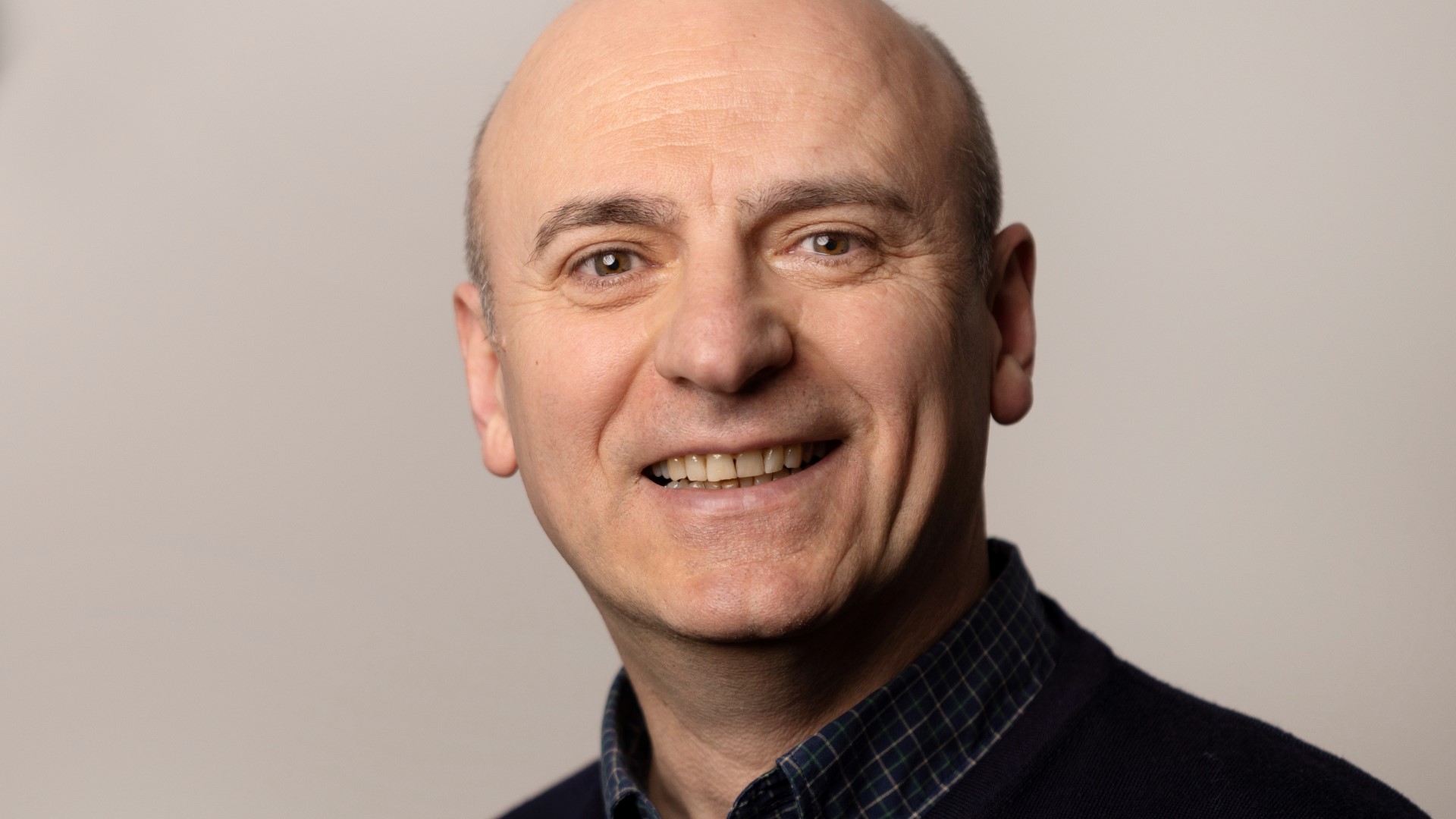
Eugen Stamate awarded the degree of Doctor Technices
Senior researcher at DTU Nanolab, Eugen Stamate, has discovered something tiny that could significantly impact the development of sensors for the Internet of Things and open a vast business potential. On 4 April 2024, he defended his doctoral dissertation: '3D Plasma-sheath-lenses: phenomenology and applications.'
Photo: Mikal Schlosser
Friday 05 April 2024
Mie Harthing Egefelt
By the end of the year, there will be more than 20 billion devices (generally referred to as the Internet of Things - IoT) connected to networks directly impacting healthcare, manufacturing, retail, agriculture, and transport. This means there is a growing need to produce more compact microchips and sensors faster and cheaper than is currently possible.
Eugen Stamate's discovery of plasma-sheath-lenses and their ability to control charged particles such as electrons and ions is crucial to developing new micro- and nanofabrication technologies to meet this need. In 2012, Eugen was awarded with the ‘Plasma Physics Innovation Prize’ by the European Physical Society for the discovery of the modal and discrete focusing effects.
Stamate's groundbreaking research into the 3D plasma-sheath-lens-concept is also at the heart of the Grand Solutions project, Smart3D, supported by the Innovation Fund Denmark. The project aims to design new nanomanufacturing equipment and establish improved processing methods for thin film deposition, ion implantation, and etching on substrates up to 300 mm in diameter.
The dissertation summarises Eugen Stamate's research publications on the phenomenology and applications of 3D-plasma-sheath-lenses, and can be found in full on DTU FindIt.
The Academic Council will officially award Eugen Stamate the degree of Doctor Technices on Tuesday 9 April.
FaCT
The degree of Doctor Technices
The degree of Doctor Technices (dr. techn.) is the highest Danish academic honour in engineering and technical and natural sciences.
The first degree of Doctor Technices was awarded at DTU in 1918. Since then, more than 200 people have received the degree.