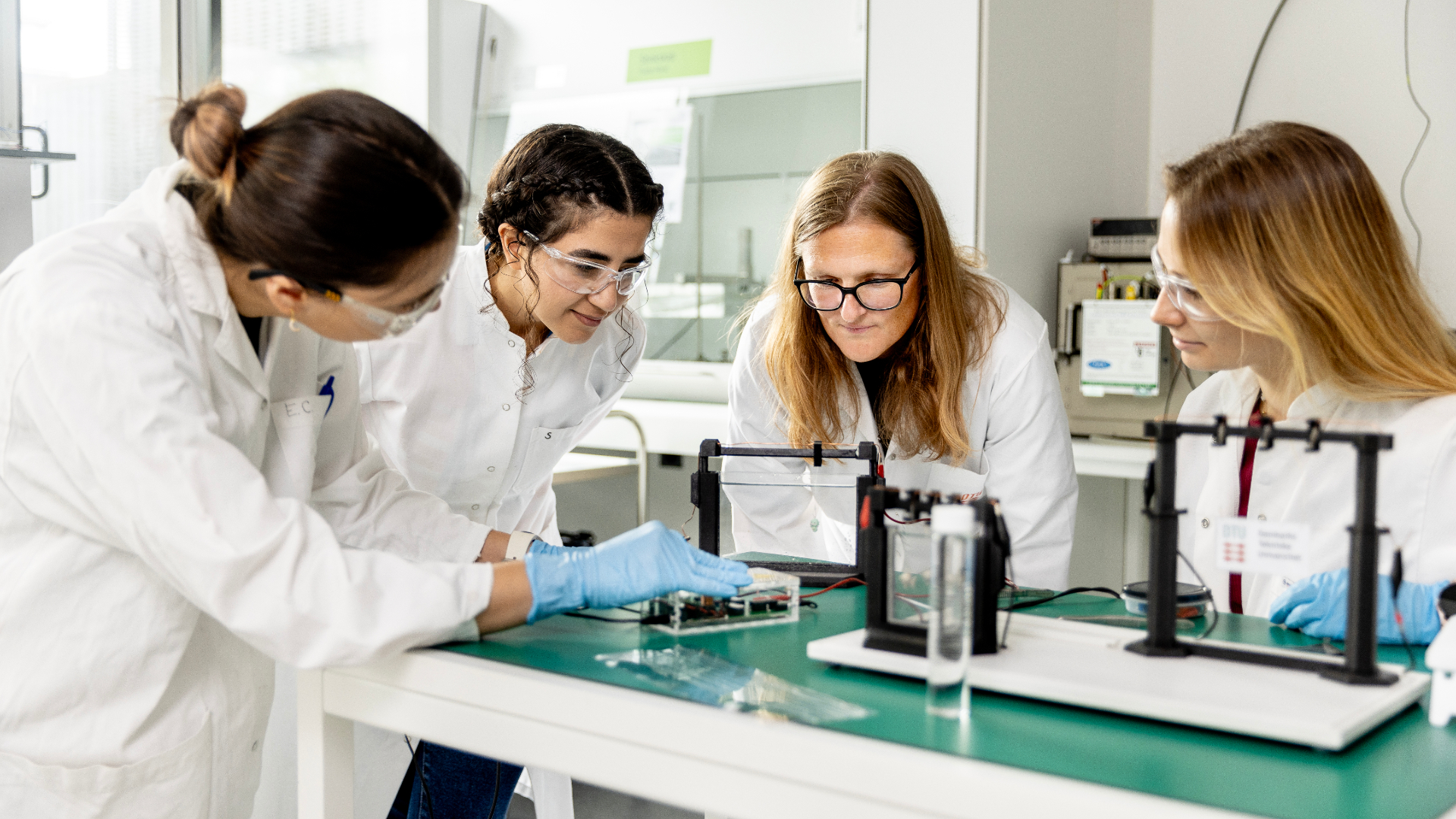
For several years, DTU has worked systematically to ensure equal opportunities for all, in order to attract the best talent regardless of gender.
This is reflected in the latest figures for PhD students. While the overall proportion of female PhD students has remained stable at 35–37% since 2008, preliminary figures for 2025 show that 43% of newly enrolled PhD students are women.
“This means we have reached a critical mass of over 30% of the underrepresented gender, which research shows is necessary to attract more women. It is a success because it creates better research environments while increasing the talent pool,” says Camilla Rygaard-Hjalsted, Dean of Sustainability, Diversity, Inclusion, and Talent Development.
Research excellence is the starting point
For DTU’s Executive Board, attracting the most talented individuals regardless of gender and background is a top priority. Much of the work takes place locally at the departments, such as DTU Compute.
Mathematics, statistics, and computer science have traditionally been fields of research with lots of men, but that is changing. This is evident at DTU Compute, where the proportion of female PhD students has risen from 18% in 2021 to 41% in 2024.
At DTU Compute diversity and inclusion are regular topics on the agenda in many of the department’s activities – for example, a contact person initiative has been established, allowing employees to report instances of discrimination or sexism.
“Simply putting the topic on the agenda has created greater awareness,” says Sabrina Spangsdorf, PhD Coordinator and Head of Diversity.
“At its core, this is a cultural change. There are stereotypes suggesting computing is a male-dominated culture, where women might wonder if they will fit in. So we try to make it clear that we do not live up to that prejudice.”
For Sabrina Spangsdorf, it is not about meeting a specific quota:
“Our starting point is to deliver high-quality research and teaching, and we cannot produce good research if we become too homogeneous. Research shows that the more diversity you have in your research group, the greater the likelihood of gaining new perspectives, making research more qualified and valuable,” she says.
Learn best when you can ask questions freely
Chiara-Marie Zok is pursuing her PhD at DTU Compute in the Cybersecurity Engineering section – a section that has grown from three female employees in 2022 to employing 13 women today.
When Chiara-Marie Zok completed her master’s degree at another university, women made up less than 10%, and she previously worked part-time as a software engineer in a team with very few women.
“I experienced a lot of sexist jokes and often felt that no one listened to me. So it was important for me to choose a research group where I wouldn’t be the only woman,” says Chiara-Marie Zok, adding:
“As a PhD student, it’s important to feel safe enough to ask questions – because that’s how you learn and progress much faster. And that can be difficult if you’re in a work environment as the only woman.”
18 months into her PhD project, Chiara-Marie Zok feels seen – and heard – by her colleagues at DTU Compute.
“Our head of section often talks about diversity at our section meetings, and he always says that if we as women experience anything inappropriate or want to discuss something, his door is always open. And it really feels like he means it,” she says.
No tolerance for sexism
In 2024, a report from the Danish National Research and Analysis Centre for Welfare (VIVE) pointed out that academic environments with a low proportion of women are particularly vulnerable to sexist incidents, reducing the likelihood that female PhD students will continue in academic careers after completing their PhD.
“DTU has taken the report very seriously, and I want to emphasise that DTU does not accept any form of sexism. That is why we are working systematically to ensure a safe and supportive work culture for everyone,” says Camilla Rygaard-Hjalsted.
DTU has, for example, introduced a PhD supervisor training programme to ensure supervisors focus on well-being in the workplace. This aims to give PhD students a better start to their research careers.
Although gender balance is slowly improving at DTU, Camilla Rygaard-Hjalsted is aware that much work remains:
"It is important to stress that we are by no means there yet. However, as each department reaches a critical mass of over 30% of the underrepresented gender, which research shows is necessary to attract and retain more women, we are on the right track. And we will continue to do everything we can to ensure that DTU is a good place to work for everyone," she says.