DTU's clean room provides reassurance for chip manufacturers
The startup SBT Instruments rents DTU's clean room in order to produce measuring chips for its customers and avoid supply problems and fluctuating quality.
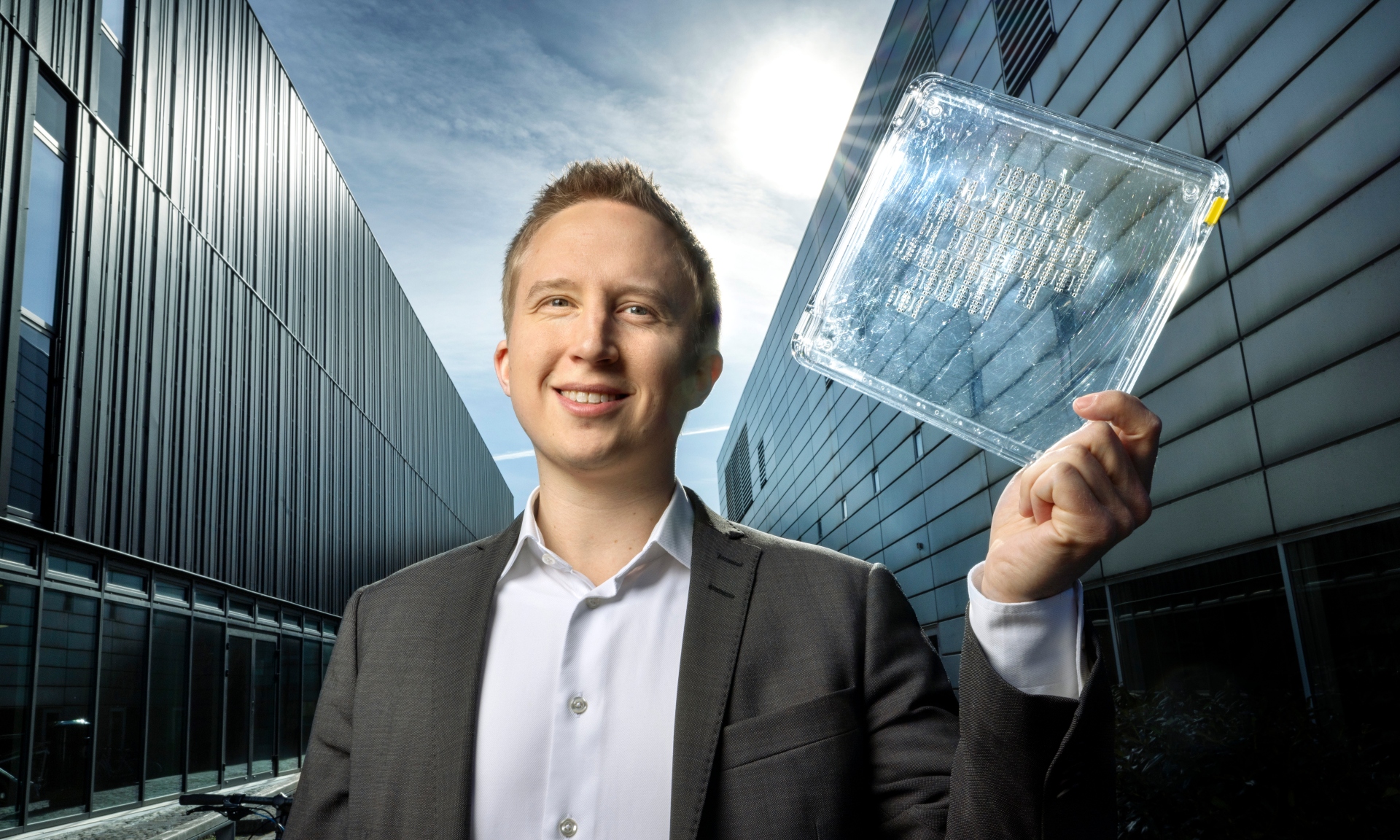
Keeping the production in DTU´s clean room in Denmark gives CEO and co-founder of SBT Instruments Gustav Skands control of quality and supply. Photo: Mikal Schlosser.
Monday 02 May 2022
Peter Aagaard Brixen
Small production batches of chips for measuring equipment can be quality-sensitive items when you order them from international suppliers. That’s why the startup SBT Instruments has rented DTU’s clean room. There, they produce a chip for the BactoBox measuring device which is used to measure bacterial concentrations in samples within a few minutes. Keeping the production in Denmark gives SBT Instruments control of quality and supply, and this is crucial for the companies that have bought a BactoBox and need to change the product's flow cell chip after every 250 measurements.
“We’re completely dependent on being able to deliver new flow cells to our customers so they can perform their measurements. Previously, we had them manufactured abroad, but as a small customer of the major manufacturers, we’ve experienced problems with waiting times and quality, and we can’t live with that. Therefore, it’s crucial for us to be able to use the clean room and gain control over the quality and delivery times,” says Gustav Skands, CEO and co-founder of SBT Instruments.
Renting machines in the clean room
SBT Instruments is one of the 250 customers using machines and rooms in DTU Nanolab's clean room, where the filtered air is replaced twice a minute and has a very low concentration of airborne particles. The flow cells and microchips must be produced in clean rooms to prevent dust particles from contaminating the micro- and nanostructures that researchers and companies manufacture. Everyone who works in the clean room must therefore wear a full suit, hood, boots, gloves, and aren’t allowed to eat, drink, or use mobile phones.
Large companies often rent a shielded area of the clean room, while SBT Instruments rents in order to use special machines to produce their flowcell.
“It would be extremely expensive to establish our own clean room, so it’s key for a company like ours to be able to rent one. Once we get more revenue, we’d like to have our own machines and more space in DTU's clean room. This is essential for us to be able to expand our production. The alternative would be that we’d have to move some of our production abroad as we grow," says Gustav Skands.
Results ready in minutes
SBT's BactoBox is based on a new approach to measuring bacteria in a sample. Whereas the traditional counting process is done on agar plates in petri dishes and take 1–3 days, BactoBox is based on an impedance flow cytometry, where the bacteria present in a sample are passed through a chip, a microfluidic flow cell. Inside the cell, the bacteria pass through a channel between two electrodes that can detect the bacteria based on their electrical properties and sizes. This creates a kind of fingerprint that makes it possible to count them. The test results are ready in a few minutes.
The BactoBox technology is relevant for companies that produce bacteria (e.g. for food fermentation) and companies that use bacterial fermentation to produce enzymes or other molecules.
SBT Instruments was established as a startup company in DTU in 2014. It had a turnover of DKK 7 million in 2021, mainly from customers in Europe and the US.
Contact: Gustav Skands, CEO at SBT Instruments, Mobile: (+45) 20 76 57 73, mail: ges@sbtinstruments.com
Queue for DTU's clean room
The clean room at DTU is Denmark's only large-scale cleanroom, and is used both by high-tech companies outside DTU and by students who, as part of their degree programmes or research projects, need an advanced clean room to produce nano- and microtechnology.
There’s an increasing demand for facilities for chip production across the world, and we’re also experiencing this at DTU, where four companies are queuing up and many of the current users want more space. In addition, a certain buffer capacity is needed in the clean room so that researchers can apply to carry out new projects and document to foundations that they can do their research in the clean room.
DTU Nanolab, the National Centre for Nanofabrication and Characterization, provides access to advanced developments in micro- and nanotechnology and plays a key role in the field in Denmark and abroad.
In a new proposal drawn up together with the Confederation of Danish Industry and the Danish Metal Workers’ Union, DTU calls for the government to enter into a public-private collaboration and invest in an expansion of existing laboratory facilities. The expansion of the clean room will ensure that Denmark achieves market and supply security in a technology area that is vital for companies.
Theme on chip technology
Microchips have become a key technology in the digital society. Denmark needs strong research environments and a large-scale clean room for chip production in order to be able to develop the nano- and microchips of the future. Read DTU's theme on chip technology.