Get a Master's degree in Mechanical Engineering

Master of Science (MSc) in Mechanical Engineering

Mechanical engineering is at the core of countless technologies. In the Master of Science (MSc) in Mechanical Engineering, you will gain a deep understanding of mechanics and learn to apply it across a remarkable range of scales; from microstructures in hearing aids and mobile phones to engines, turbines, wind turbines, ships, and offshore structures.
Mechanical Engineering

Mastering mechanics—improving the world around us

Whether you are interested in designing products, improving energy systems, analysing complex structures and machinery, or understanding how fluids behave, this programme gives you both the scientific foundation and the practical skills to turn ideas into efficient solutions.

The MSc in Mechanical Engineering rests on three pillars: structural strength and dynamics, fluid flow, and energy conversion. Building on this foundation, you gain insight into systematic design and analysis methods, numerical simulation, and optimisation.

You will develop skills in formulating advanced mathematical models, testing them through simulation and laboratory experiments, and judging whether the results can be trusted. Alongside classical methods, you gain the competences to work with data-driven and AI-supported tools for design and simulation and to critically assess when and how they can add value.

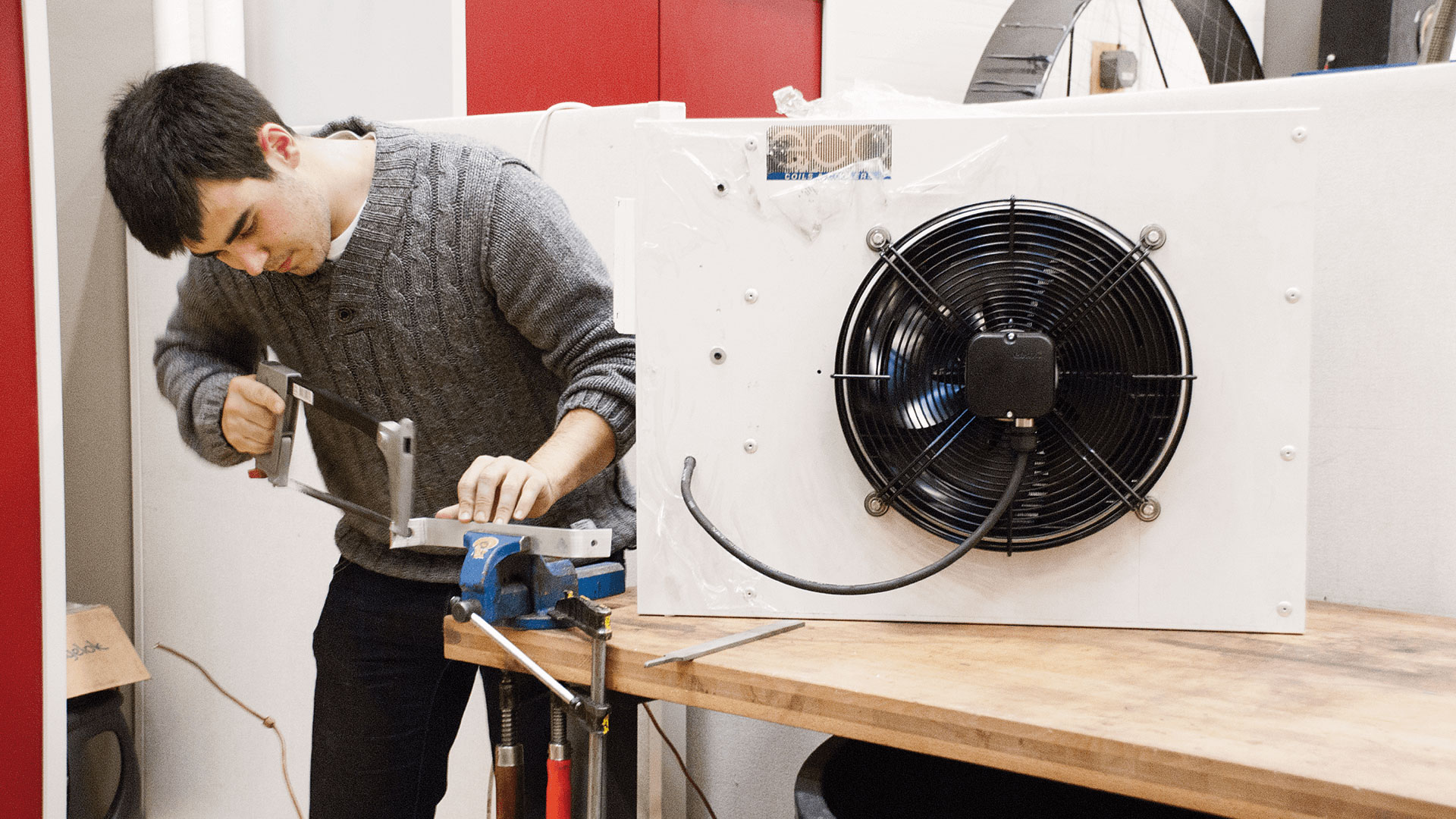
During your studies, you will work both individually and in interdisciplinary teams with access to advanced laboratories and testing facilities where theory meets measurement.

As a graduate, you will have the competences to develop products, machinery, production equipment, and large-scale installations that industry and society depend on—and to make them perform better, last longer, and use fewer resources.


Specializations

The MSc in Mechanical Engineering allows you to shape your academic profile while maintaining a strong foundation in mechanics. You are admitted to the programme rather than a particular specialization, and you have the freedom to combine courses across the curriculum.

If you complete one of the following specializations, the specialization will be added to your diploma:

Engineering Design and Product Development

How do you find the best solutions for organising product development? This specialization covers the life cycle of a mechanical or mechatronic product—from conceptual design and systematic design to computer-based synthesis, implementation, and operation.

Strength and Dynamics of Structures

Build the skills to analyse strength, vibration, and stability, and dimension products ranging from microcomponents to production equipment and offshore rigs. Explore finite element methods, fracture mechanics, composites, and experimental solid mechanics through modelling with laboratory testing.

Industrial Fluid Mechanics

Work with industrial flow problems by combining classical physics, applied mathematics, and numerical and experimental methods. Formulate and calculate flow models, then use laboratory measurements to verify and define them.

Energy Engineering

Gain knowledge of energy conversion, storage, and efficient use: in heat pumps and refrigeration systems, combustion engines, fuel cells, power plants, and industrial installations. Drawing on thermodynamics, heat transfer, and fluid dynamics, this specialization also covers green fuels and power-to-X technologies central to the energy transition.

Naval Architecture and Offshore Engineering

Design, build, test, and operate ships, offshore wind turbines, wave energy converters, and aquaculture facilities. Combining hydrodynamics, wave loads, and structural mechanics, you will focus on safe, cost-effective structures with minimal environmental impact. This specialization requires a maritime-oriented BSc background and follows a fixed study plan.

Combine work with study!

You have the the opportunity to join an Industry Master of Science in all DTU's master's programmes.

Combining work and study, an industry master's programme is the ideal way to apply your academic knowledge in real-world settings and build a strong foundation for your future career.
Learn more about the Industry MSc

Future opportunities

Mechanical engineers are in high demand wherever products, machines, and physical systems are designed, analysed, and improved. Graduates work in R&D divisions or large companies, smaller high-tech niche firms, engineering consultancies, and research institutions.

Typical work includes developing new engineering designs and dimensioning products and production equipment, optimising energy conversion processes, and analysing structural integrity and flows in turbines, wind turbines, ventilation systems, and maritime structures.

You could develop medical devices and production equipment at Novo Nordisk, work on large-scale engines and propulsion systems at Everllence, design blades at LM Wind Power, develop catalysis and power-to-X technology at Topsoe, build offshore wind projects at Ørsted, or work as a consulting engineer at Rambøll, Cowi, or DNV.

Many graduates join specialist engineering companies or start their own.

If you are drawn to research, the programme provides a strong foundation for a PhD, either at DTU or another leading university, or as an industrial PhD, where you are employed by a company while carrying out your research.


Application and admission

Admission requirements

Learn more about the academic requirements and the selection criteria for this programme.

How to apply

All you need to know about applying for admission to an MSc programme at DTU.

Any questions?